Can Rhinoplasty Improve Your Breathing and Your Looks?
Introduction
For something that sits right in the centre of your face, the nose carries a surprising amount of responsibility. It shapes how you look in photos, how you feel about your reflection, and, in ways many people do not realise, how well you breathe every single day.
Rhinoplasty, commonly known as a nose job, is one of the most requested cosmetic procedures in the world. But there is a side to it that often gets overlooked in conversations about appearance: its genuine medical value. For many patients, rhinoplasty is not just about aesthetics. It is about finally being able to breathe properly.
What Is Rhinoplasty?
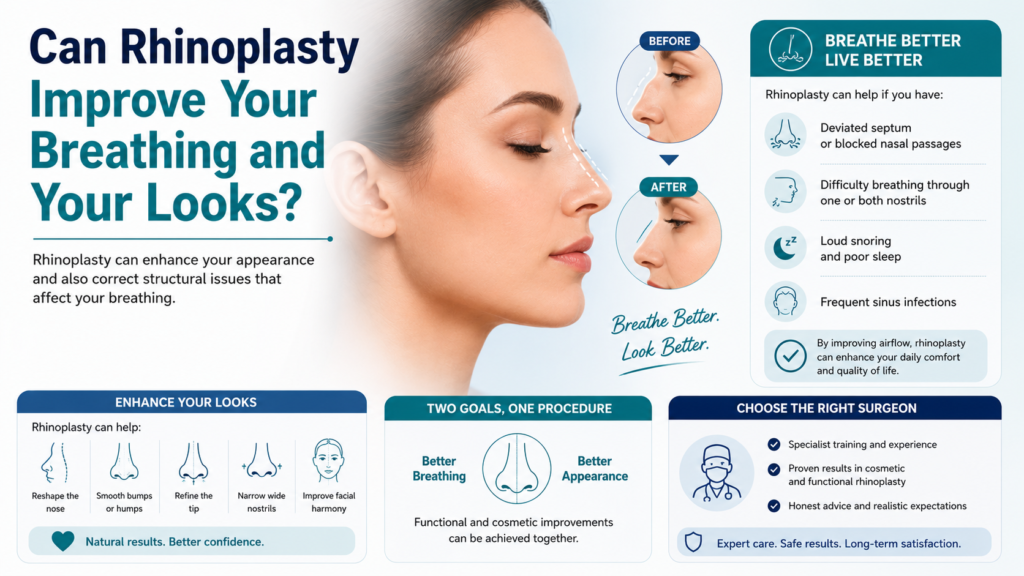
Rhinoplasty is a surgical procedure that reshapes the nose. Depending on what a patient needs, it can involve changing the size or shape of the nose, refining the tip, smoothing a bump on the bridge, adjusting the nostrils, or correcting internal structural problems that affect airflow.
There are two broad types:
- Cosmetic rhinoplasty: focused on improving the appearance of the nose
- Functional rhinoplasty: focused on correcting structural issues that interfere with breathing
In many cases, both goals are addressed in the same procedure. A patient comes in wanting a straighter nose and discovers that a deviated septum has been quietly making their nights harder than they need to be. One surgery, two meaningful outcomes.
When Breathing Is the Real Problem
A deviated septum is one of the most common reasons people struggle to breathe through their nose. The septum is the wall of cartilage and bone that divides the nose into two nostrils. When it leans significantly to one side, which happens in a surprising number of people, sometimes from birth, sometimes after an injury, it narrows one or both nasal passages.
The result can include:
- Chronic nasal congestion that does not respond to medication
- Difficulty breathing through one or both nostrils
- Loud snoring or disrupted sleep
- Frequent sinus infections
- Dry mouth from habitual mouth breathing
A septoplasty, the part of the surgery that straightens the septum, is often performed alongside cosmetic reshaping. Together, they are sometimes called septorhinoplasty.
Enlarged turbinates (small structures inside the nose that can become swollen and block airflow) can also be addressed during the same procedure, further improving nasal function.
The Cosmetic Side: What Can Rhinoplasty Actually Change?
This is where expectations need to be realistic — and a good surgeon will always make sure they are.
Rhinoplasty can effectively:
- Reduce or increase the overall size of the nose
- Smooth out a visible bump or hump on the bridge
- Refine a bulbous, drooping, or upturned tip
- Narrow wide nostrils
- Improve symmetry between the nose and the rest of the face
- Reconstruct the nose after injury or previous surgery
What it cannot do is transform your face into someone else’s, or guarantee a specific outcome down to the millimetre. The nose heals over months, and final results can take up to a year to fully settle. A skilled Plastic Surgeon will always show you realistic before-and-after examples, discuss what is achievable for your unique facial structure, and make sure your expectations are grounded in what surgery can genuinely deliver.
Choosing the Right Surgeon
This is possibly the most important decision in the entire process. Rhinoplasty is one of the most technically demanding procedures in cosmetic surgery. The nose is complex, sits at the centre of the face, and small changes have large visual effects.
When choosing a surgeon, look for:
- Specialist training and certification in plastic or facial surgery
- A strong portfolio of rhinoplasty results, both cosmetic and functional
- A consultation process that feels unhurried and honest
- Clear communication about risks, realistic outcomes, and recovery
A trustworthy Plastic Surgeon will never pressure you into a decision or promise results that sound too good to be true. The right consultation should leave you feeling informed, not rushed.
Both Goals Are Worth Having
There is sometimes an unspoken sense that wanting to change how your nose looks is somehow less valid than wanting to fix how it functions. That is not a useful distinction. Feeling confident in your appearance is a legitimate and deeply human concern, and when a single procedure can address both form and function, that is genuinely good medicine.
Whether breathing is your primary motivation, appearance is, or both carry equal weight, rhinoplasty, when performed by the right hands, can make a meaningful difference to your daily life. Dr. Shraddha Deshpande works with patients navigating exactly this decision every day, helping them understand their options clearly and move forward with confidence, whatever their reason for being there.